
Private Label Caffeine Pouch Packaging | 200mg Energy & Nootropic Cans
Food-grade caffeine pouch packaging from 1,000-unit samples. PP and aluminum cans with FDA 21 CFR 177.1520 compliance and custom labeling.
The caffeine pouch market is no longer a niche. What started as a curiosity in Nordic fitness circles has evolved into a global functional product category, with brands now offering everything from 50mg micro-dose energy pouches to 200mg nootropic blends infused with L-theanine and terpenes. For brand owners and product developers, the opportunity is clear — but so is the operational challenge: caffeine pouches are not nicotine pouches, and the packaging assumptions that work for one category can fail spectacularly in the other.
Why Functional Pouch Brands Need a Specialized Partner
Nicotine-focused suppliers do not understand functional formulas
Caffeine is hygroscopic — it absorbs moisture and clumps in a standard nicotine pouch can within weeks. Nootropic actives like L-theanine and B-vitamins need oxygen and UV barriers that tobacco-grade packaging simply does not provide.
Regulatory gray zone creates compliance risk
Caffeine pouches are food or dietary supplements, not tobacco. They need FDA 21 CFR 177.1520 food-contact compliance and EU 10/2011 migration certificates — not CR certifications. A supplier who only knows nicotine may ship you packaging that clears customs but fails a retailer audit.
Limited decoration options at low volume
Many suppliers reserve premium printing and embossing for 50,000+ orders. Early-stage functional brands need brand impact at 10,000 units — or even 1,000 units for market testing — to stand out on shelf.
Caffeine Pouches Are Not Nicotine Pouches
The can looks identical, but the engineering priorities differ. A nicotine-focused supplier can degrade your functional product in 60 days.
Ingredient Sensitivity
Caffeine is hygroscopic, meaning it readily absorbs moisture from the air. In an improperly sealed container, caffeine pouches can clump, degrade, or develop off-flavors within weeks. Nicotine, while also sensitive to oxidation, has different stability profiles and often benefits from the presence of humectants that would harm caffeine formulations.
Flavor Volatility
Caffeine pouches rely heavily on volatile flavor compounds — mint, citrus, berry, coffee — that dissipate faster than the tobacco or mint bases typical of nicotine pouches. This means the packaging must provide a superior oxygen and aroma barrier.
Light Sensitivity
Many caffeine and nootropic ingredients, including certain B-vitamins and botanical extracts, are photodegradable. Clear or translucent packaging that works for nicotine pouches can destroy product efficacy for caffeine formulations.
Regulatory Classification
Nicotine pouches are regulated as tobacco or pharmaceutical products in most markets. Caffeine pouches are regulated as food or dietary supplements, which triggers an entirely different compliance framework focused on food-contact materials rather than child-resistant requirements.
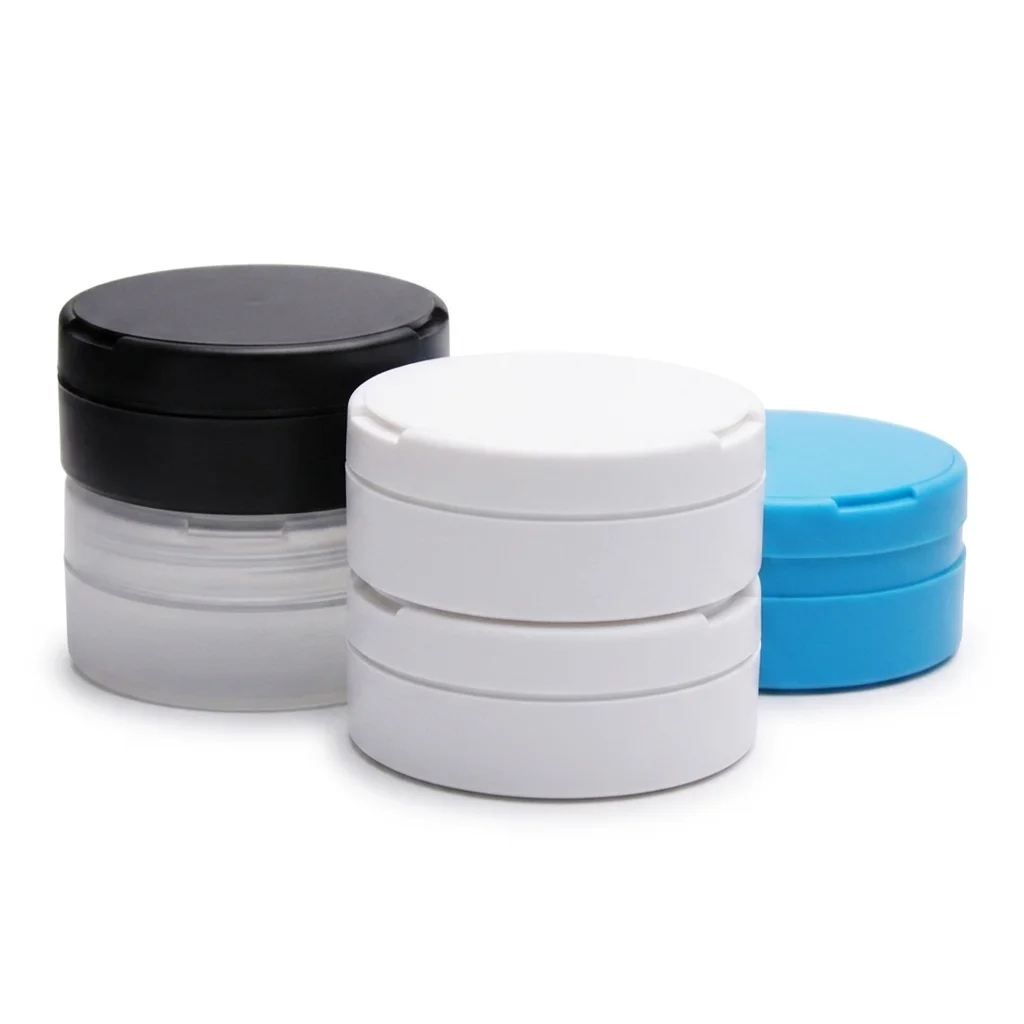
16+ SKU Platform — Caffeine-Compatible Formats
Proven geometries already in production. No custom tooling delays.
| SKU Family | Dimensions | Closure | Best For |
|---|---|---|---|
| Standard snap-fit | Ø70.3 × 24.85 mm | Snap-fit | Cost-conscious launches, multi-SKU testing |
| Mini flip-top | Ø60.14 × 20.88 mm | Mini flip-top | Travel sizes, sampler programs |
| Hinged standard | Ø70.3 × 24.85 mm | Hinged flip-top | Used-pouch compartment for on-the-go consumers |
| Child-resistant | Ø69.8 × 20.4 mm | Push-and-turn | Markets requiring CR |
Packaging Requirements for Functional Pouches
Two non-negotiable pillars: food-grade compliance and barrier engineering.
Food-Grade Material Compliance
Caffeine pouches are classified as food or dietary supplements. Primary packaging must comply with FDA 21 CFR 177.1520 for olefin polymers and EU 10/2011 for overall migration limits.
- • Migration limits — total extractives within FDA thresholds (n-heptane, 95% ethanol)
- • Additive restrictions — only FDA-approved additives, colorants, and processing aids
- • GMP — production follows FDA GMP guidelines for food-contact articles
- • FDA 21 CFR 177.1520 + EU 10/2011 compliant resins
- • Batch-specific compliance certificates with every order
Moisture, Oxygen & UV Barriers
Moisture and oxygen are the two factors that determine shelf life. Standard PP supports 6 months in temperate climates; EVOH-enhanced or aluminum extends to 12+ months.
- • WVTR — standard PP: 0.5–1.0 g/m²/day at 38°C / 90% RH
- • EVOH barrier layer — reduces WVTR and OTR by 60–80%
- • OTR — standard PP: 50–100 cc/m²/day; EVOH: 5–10 cc/m²/day
- • Built-in desiccant chamber for residual moisture control
- • Aluminum construction — near-zero moisture and oxygen transmission
- • UV protection — Riboflavin half-life ~48 hours in clear packaging; opaque PP or aluminum blocks 99% of UV
Proof You Can Verify
~$0.08–0.11/pc
Standard snap-fit PP cans, depending on volume and configuration
1,000 pcs
Sampling program for market testing — delivered in 10–14 days
16+ SKUs
Proven can geometries — snap-fit, hinged, mini, slim — no custom tooling delays
FDA + EU
Batch-specific food-contact compliance certificates with every order
EVOH
Optional barrier-layer PP reduces moisture and oxygen transmission by 60–80%
Simpler
No TPD, no tobacco pre-market approval — food-supplement regulatory path
Material Compatibility Testing Included
Before production, we run a 30-day accelerated stability test with your actual formula in our packaging. You receive a compatibility report showing moisture ingress, pH drift, and seal integrity — so you know your product stays fresh on shelf.
Case Study — How an Energy Brand Launched Caffeine Pouches in 8 Weeks
In late 2025, a U.S.-based fitness supplement brand (name withheld for confidentiality) identified caffeine pouches as a high-growth extension of their pre-workout product line. Their challenge was speed: they needed to launch before the Q1 fitness resolution season, giving them less than 10 weeks from concept to first sale.
Week 1–2
Format and Flavor Selection
The brand chose a 100mg caffeine + L-theanine blend in a 0.6g mint-flavored pouch. MANKE recommended the standard PP can with EVOH barrier layer for 12-month shelf life.
Week 3–4
Design and Artwork
MANKE's design review identified that the brand's initial label design used a font size too small for FDA supplement facts requirements. Revised artwork was approved within 48 hours.
Week 5–6
1,000-Unit Sample Production
Samples were distributed to 50 fitness influencers and placed in three retail test locations. Consumer feedback confirmed strong flavor appeal and no packaging usability issues.
Week 7–8
Production Launch
10,000-unit production run with custom green color-molded PP cans and full CMYK wrap-around labels. Product launched on the brand's DTC website and two regional supplement retail chains. The brand sold through its initial 10,000-unit run in 14 weeks and placed a 50,000-unit reorder with MANKE, adding a second flavor variant (citrus-ginseng) using the same can platform.
Caffeine vs Nicotine — Side-by-Side Comparison
The physical can may look identical, but the engineering priorities and compliance frameworks are substantially different.
| Feature | Caffeine Pouch Packaging | Nicotine Pouch Packaging |
|---|---|---|
| Primary regulation | FDA food-contact (21 CFR 177.1520) / EU 10/2011 | FDA tobacco / CPSC PPPA / TPD |
| Child-resistant requirement | Generally not required | Mandatory in U.S., Australia, many EU |
| Material compliance focus | Food-grade migration, additive safety | Chemical resistance, child-safety mechanism |
| Moisture barrier priority | High — caffeine is hygroscopic | Moderate — nicotine benefits from humectants |
| Oxygen barrier priority | High — flavor and ingredient stability | Moderate — nicotine oxidation is slower |
| UV protection | Often required | Rarely required |
| Typical shelf life target | 12 months | 18 to 24 months |
| Labeling focus | Caffeine content, allergens, supplement facts | Nicotine strength, health warnings, CR markings |
| MOQ (MANKE standard) | 10,000 units (1,000 for sampling) | 10,000 units |
| Premium positioning | Aluminum for sustainability and tactile | Aluminum for brand prestige and CR compatibility |
Packaging Specs & Logistics
Standard Export Packing
- •500 pcs per carton; carton dimensions 70 × 36 × 26 cm
- •Gross weight approximately 8.2 kg per carton
- •Base and lid ship separately by default — maximizes container density and protects surfaces
- •Pre-assembled shipping available on request
Container Loading Reference
- •20'DC: approximately 210,000 pcs (loose cartons)
- •40'HC: approximately 520,000 pcs (loose cartons)
- •Palletized: 8–10 pallets per 20'DC, 18–20 per 40'HC (~10,000 cans/pallet)
- •Palletized reduces capacity by ~15–20% but simplifies warehouse handling
Raw Material Transparency
Plastic resins are crude-oil derivatives, and prices shift with geopolitical events. MANKE monitors resin indices continuously and alerts clients to expected fluctuations before they affect invoices. A production partner recently used this advance notice to lock in a quarterly frame agreement at the prior rate, saving an estimated 4–6% on packaging spend over three months.
What makes caffeine pouch packaging different from nicotine pouch packaging?
Is caffeine pouch packaging FDA compliant?
What is the MOQ for custom caffeine pouch cans?
How long does sampling take?
Can I use the same can for caffeine and nicotine pouches?
Does caffeine pouch packaging need to be child-resistant?
What shelf life can I expect from standard PP cans?
Can MANKE help with label design and regulatory review?
Why do bases and lids ship separately?
Start Your Caffeine Pouch Project
Download the Caffeine Pouch Packaging Spec Sheet for complete material specifications, barrier performance data, and compliance documentation. Or request a 1,000-unit sample order and put your formulation in packaging that performs as hard as your product does.